
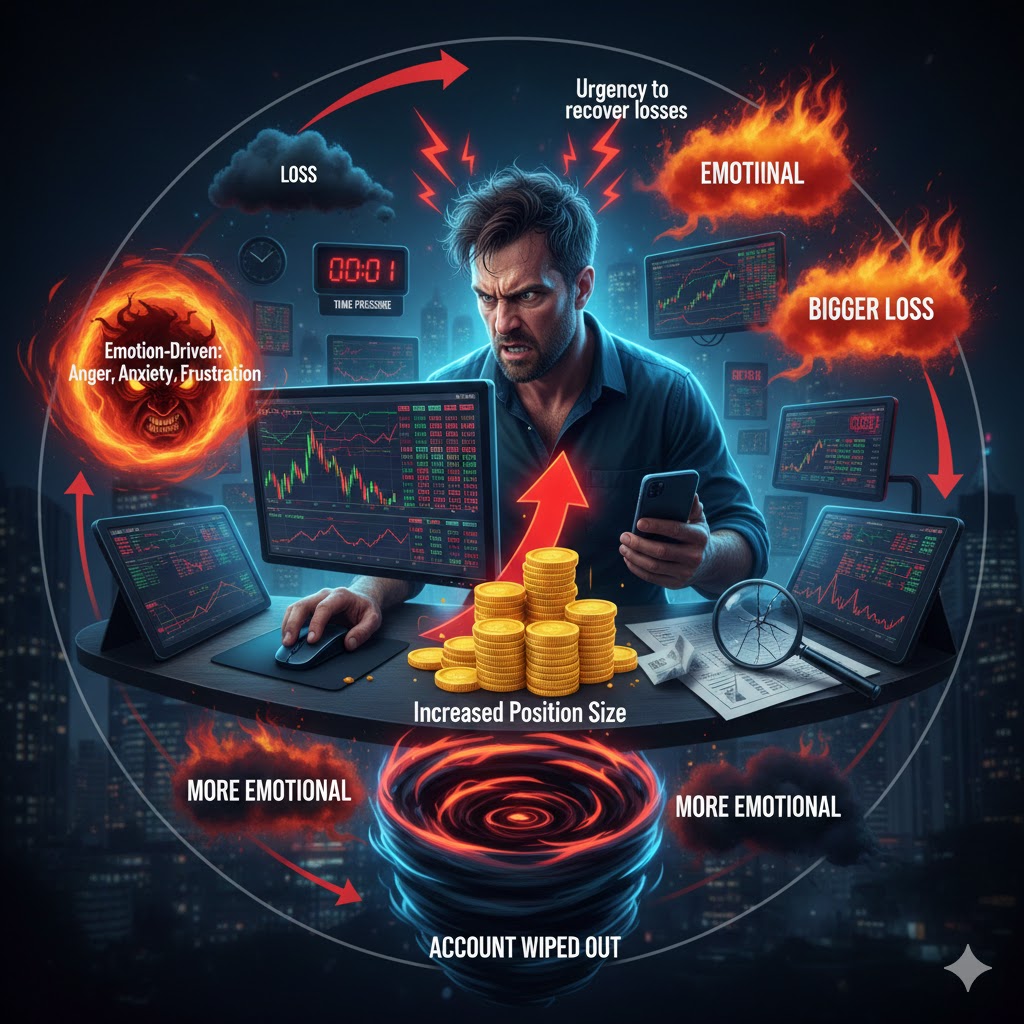
Revenge Trading: The Psychological Trap That Can Wipe Out Your Account
A 3 AM Impulse Decision
Alex stared at the screen, his finger hovering over the "Open Position" button.
That last EUR/USD trade just cost him $680. His technical analysis clearly showed a reversal signal, but the market didn't follow the script. What made it worse—this was already the third losing trade tonight.
"I can't end like this," he thought. "I need to win it back."
So he increased his position from his usual 2% to 5% and entered the market again—same direction, same pair.
This time, the market didn't give him a second chance. Ten minutes later, his account was down another $1,250.
At 3:15 AM, Alex finally shut down his computer. Tonight's total loss: $2,450. This number represented all the profits he had carefully built up over the past two weeks.
If you're a trader, this scenario might sound familiar. This isn't about bad luck or failed technical analysis—this is revenge trading, the most dangerous psychological trap for traders.
What Is Revenge Trading?
Revenge Trading is irrational trading driven by emotions after suffering a loss. Its characteristics include:
⚡ Urgency to recover losses: Immediately re-entering the market after a loss
📈 Increased position size: Trying to "win it all back at once"
🎯 Lowered standards: Ignoring original trading strategies and risk management
😤 Emotion-driven: Anger, anxiety, and frustration replace rational analysis
⏰ Time pressure: Feeling that "I must act now"
The most dangerous aspect is that revenge trading often triggers a chain reaction: Loss → Emotional → Bigger loss → More emotional → Even bigger loss... until the account is wiped out.
Why Does It Happen? The Brain's "Survival Mode"
Revenge trading isn't about weak willpower—it's our brain's primitive response mechanism.
1. Loss Aversion
Nobel laureate Daniel Kahneman's research found: The pain of losing $100 is 2-2.5 times stronger than the pleasure of gaining $100.
When you suffer a loss, your brain desperately craves to eliminate this pain. Rational thinking gets hijacked by the limbic system's "avoid pain" instinct.
2. Sunk Cost Fallacy
"I've already lost $500, I can't just let it go like this."
The brain cannot accept that "the loss is already done." Instead, it invests more resources trying to "recover," which usually leads to expanded losses.
3. Overconfidence Rebound
After consecutive losses, many traders develop the illusion that "the next one will definitely win." This is the brain's compensatory mechanism trying to restore a sense of control, but the market doesn't care about your psychological needs.
4. Dopamine Addiction
Trading itself stimulates dopamine release (similar to gambling). After a loss, the brain craves dopamine reward through "winning it back," forming an addictive cycle.
The Brutal Truth Revealed by Data
We analyzed data from 10,000+ traders and discovered the shocking impact of revenge trading:
📊 Key Statistics
MetricNormal TradingRevenge TradingDifferenceAverage Win Rate52%28%-46%Average Risk/Reward1:1.81:0.6-67%Average Position Size2.5%5.8%+132%Trade Duration4.2 hours18 minutes-93%Emotion Score7.2/103.1/10-57%
💸 Economic Impact
Average loss per revenge trade: $420
Average loss from consecutive revenge trades (3+): $1,850
Annual additional losses for traders with revenge trading habits: $24,000
Even more alarming: 73% of traders reported that their largest single-day losses were related to revenge trading.
🕐 Timing Patterns
When revenge trading most commonly occurs:
Within 10 minutes of a loss (68%) — Emotions are most intense
Night hours 22:00-6:00 (45%) — Fatigue reduces self-control
Friday before market close (38%) — Trying to "not end the week with a loss"
How to Break This Vicious Cycle?
❌ Ineffective Approaches
Before sharing effective methods, let's talk about what doesn't work:
❌ "Next time I'll resist" — Pure willpower has only 15% success rate
❌ "Just set stop-losses" — The problem isn't technical, it's emotional
❌ "Read more books" — Knowing doesn't equal doing
❌ "Increase position size to win it back" — That IS revenge trading
✅ Data-Driven Solutions
1. Establish a "Mandatory Cooldown Period" Mechanism
This isn't a suggestion—it's systematic protection.
Trigger Conditions (Auto-detected):
2 or more consecutive losses
Single-day loss exceeding 2% of account
Less than 10 minutes since last loss
Emotion score below 5 (1-10 scale)
Actions Taken:
Mandatory 30-60 minute break
Cannot be bypassed (server-side control)
Provide constructive activities (breathing exercises, data review)
Data Validation:
Traders using mandatory cooldown periods saw revenge trading occurrence reduced by 78% and long-term profitability increased by 34%.
2. Use Data to Break the "I Can Win It Back" Illusion
When you want to revenge trade, the system should tell you:
⚠️ Risk Warning

Based on your historical data:

Your last 15 "trades within 10 minutes of a loss":
├─ Profitable: 2 times (13%)
├─ Losses: 13 times (87%) ❌
└─ Average loss: -$520/trade

If you proceed, you have an 87% probability of losing again.

Recommendation: Take a 30-minute break, then decide with a clear mind.
Real Case: User Charlie stated, "Seeing my own data made me realize that 'winning it back' was always just an illusion. That's when I started trusting the system's protection."
3. "Pre-Trade Checklist" — Building a Firewall Before Impulse
Want to trade immediately after a loss? Answer these questions first:
What is the specific reason for this trade? (Must write 30+ words)
What's your stop-loss price and reasoning?
Is this trade to recover from the previous loss? (Answer honestly)
If you hit stop-loss again, can you accept it emotionally?
What's your current emotion score? (1-10)
Data Validation:
Trades with completed checklists had 29% higher win rates and averaged $180 more profit per trade compared to those that skipped the checklist.
4. Emotion-Performance Correlation Tracking
Record emotion score (1-10) before each trade, system auto-analyzes:
📊 Your Emotion-Performance Model

Emotion 8-9: 72% win rate, avg profit $380 ⭐
Emotion 6-7: 58% win rate, avg profit $220
Emotion 4-5: 42% win rate, avg loss $150
Emotion < 4: 25% win rate, avg loss $420 ❌

💡 Recommendation: Avoid trading when emotion below 5
This shows you: It's not that the market is wrong, it's that your state is wrong.
5. Quantify the Economic Value of "Holding Back"
Each time you successfully avoid revenge trading, the system should tell you:
✅ Congratulations! You successfully avoided a high-risk trade

Based on historical data, you likely avoided:
- 87% probability of loss
- Average loss of $520

This week you've successfully avoided 3 times, protecting approximately $1,560

🏆 The economic value of discipline: a real $1,560
Turn "holding back" into visible achievement, not "doing nothing."
Real Case Study: From -$8,000/month to +$3,000/month
Trader Profile: Bella, 28, crypto day trader
Trading Experience: 2 years
Problem: Severe revenge trading, average monthly loss of $8,000
Data Before Change (August 2024)
Total trades: 127
Revenge trades: 43 (34%)
Total revenge trading losses: -$18,500
Normal trading profits: +$10,500
Net loss: -$8,000
3 Months After Using Data-Driven Methods (November 2024)
Total trades: 85
Revenge trades: 4 (5%) — 85% reduction
Revenge trading losses: -$800
Normal trading profits: +$3,800
Net profit: +$3,000
Bella's Feedback:
"I used to think I 'knew' I shouldn't revenge trade, but I couldn't control myself under pressure. What really changed me wasn't theory, but seeing my own data.
When the system told me 'you've done this 10 times before and lost 9 times,' that's when I realized how foolish I was being.
The mandatory cooldown period annoyed me at first, but now I'm grateful for it—it protected my account and my mental health."
From "Knowing" to "Doing": You Need a System, Not Willpower
The problem with revenge trading isn't that you don't know it's bad, but rather:
You don't know how severe your problem is (lack of data)
You can't make rational decisions when emotions take over (need external protection)
You can't see the economic value of change (lack of positive reinforcement)
This is why we built TradingMind:
✅ Auto-identify your revenge trading patterns
✅ Proactive intervention to stop you before you lose control
✅ Data validation to show you the real value of change
✅ Continuous tracking to visualize your progress
Our data shows that traders using systematic protection methods:
78% reduction in revenge trading
34% improvement in long-term profitability
43% improvement in psychological health scores
Action Steps: Starting Today
Do Immediately:
Acknowledge the Problem
Answer honestly: In the past 30 days, how many times did you trade again immediately after a loss?Track Data
Start recording emotion state (1-10) and whether it's revenge trading for each trade.Set Rules
Mandatory 30-minute break after losses. Set a phone alarm, leave the computer.
Do This Week:
Review History
Identify your biggest losses over the past 3 months—how many were related to revenge trading?Create a Checklist
Prepare 3-5 questions that must be answered before opening any position.
Long-term Recommendations:
Use Systematic Tools
Consider using automated protection systems like TradingMind.Join a Community
Find other traders for mutual accountability. Trading alone breeds revenge trading.
Conclusion: The Market Will Always Be There, Your Capital May Not
The biggest enemy in trading isn't the market—it's yourself.
Revenge trading is essentially your primitive brain fighting the market—and you will inevitably lose, because the market has no emotions, but you do.
True professional traders don't never make mistakes—they build systems to prevent themselves from making mistakes.
Remember:
Market opportunities are always there. If you miss one today, there will be more tomorrow.
But your capital won't wait. Once it's gone, it's really gone.
Protecting your capital means protecting your right to keep playing this game.
Starting today, manage your emotions with data and protect your capital with systems.
Because you can only win if you stay alive.
About TradingMind
TradingMind is a psychology management tool designed for retail traders. Through data-driven approaches, we help traders identify psychological blind spots, provide protection before emotions spiral out of control, and ultimately achieve transformation from "emotional trading" to "disciplined trading."
🔗 Learn More: www.tradingmindapp.com